
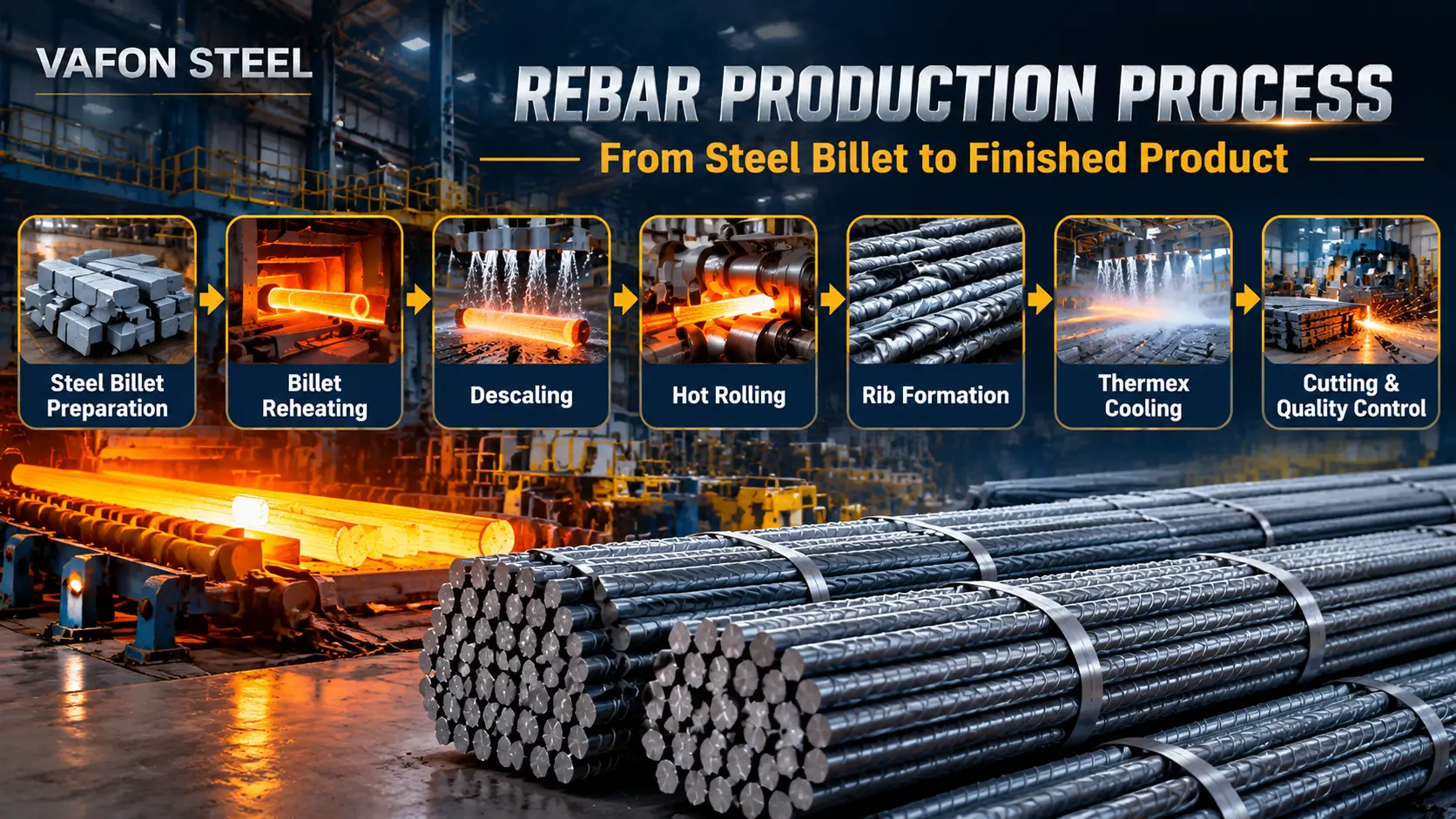
Rebar Production Process: From Steel Billet to Finished Rebar
Reinforcing steel bars, commonly known as rebar, play a vital role in modern construction. They are used to reinforce concrete structures and improve their tensile strength, durability, and overall structural performance. The quality of reinforcing steel depends on several factors, including raw material selection, chemical composition, manufacturing technology, rolling conditions, cooling methods, and quality control.
Understanding the rebar production process helps construction companies, steel distributors, importers, and industrial buyers evaluate product quality and select suitable reinforcing steel for their projects.
At VAFON STEEL, we focus on supplying reinforcing steel products that meet the technical and commercial requirements of international markets. This guide explains the main stages of rebar manufacturing, from steel billet preparation to the inspection and packaging of finished products.
1. What Is Rebar?
Rebar is a steel reinforcement bar used in reinforced concrete structures. Concrete performs well under compressive forces but has relatively low tensile strength. Reinforcing bars are embedded in concrete to help resist tensile stresses and improve structural performance.
Rebars are manufactured in different diameters, lengths, surface patterns, and steel grades. Deformed rebar has ribs or surface patterns that improve mechanical bonding with concrete.
Common applications include:
- Residential and commercial buildings
- Bridges and highway infrastructure
- Industrial facilities
- Dams and water infrastructure
- Foundations and reinforced concrete structures
- Roads, tunnels, and large construction projects
2. Raw Materials Used in Rebar Manufacturing
The primary raw material used in conventional rebar production is the steel billet.
Steel billets are semi-finished steel products with a square or rectangular cross-section. They are produced through continuous casting or other steelmaking and casting processes.
The chemical composition of the billet is essential because it affects the mechanical properties, weldability, ductility, and strength of the finished reinforcing bar.
Important chemical elements include:
- Carbon (C): Influences hardness and tensile strength.
- Manganese (Mn): Contributes to strength and hardenability.
- Silicon (Si): Acts as a deoxidizer and influences strength.
- Sulfur (S) and Phosphorus (P): Usually controlled at low levels because excessive amounts can negatively affect steel properties.
- Microalloying elements: Elements such as vanadium and niobium may be used in certain steel grades to improve strength and grain structure.
The billet must comply with the chemical and dimensional requirements specified for the intended rebar grade.
3. Main Stages of the Rebar Production Process
The conventional hot-rolling process involves several carefully controlled manufacturing stages.
3.1 Steel Billet Inspection and Preparation
Before entering the rolling mill, steel billets are inspected to verify their dimensions, surface condition, and identification.
The inspection may include checking for visible cracks, surface defects, dimensional variations, and compliance with the required chemical composition.
Proper billet preparation helps reduce production defects and supports consistent product quality.
3.2 Billet Reheating
The billets are transferred to a reheating furnace, where they are heated to a suitable temperature for hot rolling.
The required temperature depends on the steel composition, billet dimensions, furnace design, and rolling mill specifications. In many conventional processes, billets are heated to approximately 1,050–1,200°C.
Uniform heating is important because it allows the steel to deform more easily during rolling and helps prevent temperature-related inconsistencies.
3.3 Descaling
During reheating, iron oxide scale forms on the surface of the billet.
Before rolling, this scale is commonly removed using high-pressure water descaling systems. Removing the scale helps improve the surface quality of the finished rebar and reduces the risk of surface-related defects.
3.4 Hot Rolling
Hot rolling is the central stage of conventional rebar manufacturing.
The heated billet passes through a series of rolling stands equipped with specially designed rolls. Each stand gradually reduces the cross-sectional area of the billet and increases its length until the required bar diameter is achieved.
The rolling sequence is designed to maintain suitable temperature, dimensional accuracy, and material flow throughout the process.
The number and arrangement of rolling stands depend on the mill configuration, production capacity, and product specifications.
3.5 Rib Formation
Deformed reinforcing bars have ribs or patterns on their surface to improve mechanical bonding with concrete.
These ribs are formed by specially designed finishing rolls during the final stages of rolling.
The rib geometry, spacing, and dimensions are controlled according to the applicable product standard. Correct rib formation is important for the performance of reinforcing bars in reinforced concrete structures.
3.6 Controlled Cooling and Thermex Technology
After leaving the finishing stand, reinforcing bars may undergo a controlled cooling process.
One widely used technology is the Thermex process, also known as quenching and self-tempering.
In this process:
- The hot bar passes through a water-cooling system immediately after rolling.
- The surface is rapidly cooled, forming a hardened outer layer.
- The heat remaining in the core flows toward the surface.
- This heat helps temper the outer layer.
- The bar then cools further under controlled conditions.
The result is a reinforcing bar with a strong outer structure and a more ductile core.
Thermex is not the only method used to achieve the required mechanical properties. Depending on the steel grade and production technology, manufacturers may also use microalloying and controlled rolling approaches.
3.7 Cutting and Cooling Bed
After the rolling and cooling stages, the reinforcing bars are transferred to a cooling bed.
The bars are allowed to cool under controlled conditions before being cut to the required commercial lengths.
Common commercial lengths vary by market and customer requirements. The final dimensions must comply with the applicable product specification and order.
3.8 Bundling, Marking, and Packaging
Once the bars have cooled and been cut, they are collected into bundles.
The bundles are tied securely and may be marked with information such as:
- Manufacturer identification
- Steel grade
- Nominal diameter
- Product standard
- Batch or heat number
- Bundle weight
- Traceability information
Proper packaging and identification are particularly important for transportation, storage, customs clearance, and international trade.
4. Quality Control in Rebar Manufacturing
Quality control is essential throughout the production process. It helps ensure that reinforcing bars meet the required dimensional, chemical, and mechanical specifications.
Depending on the applicable standard and inspection plan, quality control may include:
Chemical Composition Analysis
Laboratory testing is used to verify the chemical composition of the steel and confirm that it meets the specified limits.
Tensile Testing
Tensile tests determine important mechanical properties, including yield strength, tensile strength, and elongation.
Bend and Rebend Tests
These tests evaluate the ability of reinforcing bars to withstand bending without unacceptable cracking or failure.
Dimensional Inspection
The nominal diameter, length, mass per unit length, and other relevant dimensions are checked against the product requirements.
Surface Inspection
The surface is examined for defects that could affect product quality or compliance with the applicable standard.
Traceability and Documentation
Production batches should be identifiable through suitable markings and inspection documents. Mill Test Certificates (MTCs) are commonly used to report relevant chemical and mechanical test results.
5. Different Methods of Rebar Production
The mechanical properties of reinforcing bars can be achieved through different production technologies. The appropriate method depends on the required steel grade, production equipment, and applicable standard.
5.1 Conventional Hot-Rolled Rebar
Conventional hot-rolled rebar is manufactured by heating steel billets and passing them through a series of rolling stands.
Its final properties depend on the billet chemistry, rolling conditions, and any subsequent controlled cooling or heat treatment.
5.2 Thermomechanically Treated Rebar
Thermomechanical treatment combines hot rolling with controlled cooling and temperature management.
Thermex is one example of this approach. It produces a hardened outer layer and a comparatively ductile core through quenching and self-tempering.
5.3 Microalloyed Rebar
Microalloyed reinforcing steel uses small additions of elements such as vanadium or niobium to improve strength and other mechanical properties.
Its performance is influenced by chemical composition, grain refinement, and controlled rolling conditions.
These methods are not interchangeable product grades. The finished bar must always be tested and certified against the required product standard.
6. Rebar Grades and International Standards
Reinforcing bars are manufactured according to national and international standards. These standards define requirements for chemical composition, mechanical properties, dimensions, surface geometry, testing, and product identification.
Some widely recognized standards include:
- ASTM A615/A615M: Standard specification for deformed and plain carbon-steel bars for concrete reinforcement.
- ASTM A706/A706M: Standard specification for low-alloy steel reinforcing bars intended for applications requiring controlled tensile properties and enhanced weldability.
- BS 4449: British standard for steel for the reinforcement of concrete.
- EN 10080: European standard framework for weldable reinforcing steel.
- GOST standards: Relevant national and regional standards used in several markets.
Steel grades such as A2, A3, and A4 are designations used in certain regional classification systems. They should not automatically be treated as equivalent to ASTM, BS, or EN grades. Buyers should verify the actual standard, mechanical properties, and chemical composition before placing an order.
7. Factors That Determine Rebar Quality
Several factors influence the quality and performance of reinforcing steel:
- Raw Material Quality: The chemical composition and condition of the steel billet.
- Reheating Conditions: Uniform heating and suitable rolling temperature.
- Rolling Accuracy: Correct reduction, dimensional control, and rib formation.
- Cooling Technology: Appropriate cooling conditions for the intended steel grade.
- Quality Testing: Reliable laboratory and dimensional inspections.
- Product Traceability: Clear identification of production batches and test documentation.
- Compliance with Standards: Verification against the standard specified in the purchase contract.
For international buyers, checking the relevant test certificate and confirming the required standard before shipment are important steps.
8. Rebar Supply and Export Services by VAFON STEEL
VAFON STEEL provides steel sourcing and export services for customers in international markets.
We support buyers looking for reinforcing steel products based on their required specifications, quantities, delivery destinations, and commercial conditions.
Our services include:
- Sourcing reinforcing steel from qualified manufacturers
- Supply of different rebar diameters and grades, subject to availability
- Coordination of product specifications and quality documentation
- Commercial support for bulk orders
- Export and shipment coordination
- Official supply contracts based on agreed terms
We work with buyers who require reliable sourcing, clear product specifications, and professional coordination throughout the purchasing process.
For customers interested in the raw material used in rebar manufacturing, visit our Steel Billet page.
You can also explore our A4 Reinforcing Steel product page for additional product information.
9. Frequently Asked Questions About Rebar Production
What is the main raw material used to manufacture rebar?
Steel billet is the primary raw material used in conventional hot-rolled rebar production. It is heated and passed through rolling stands to produce reinforcing bars with the required dimensions.
How is rebar manufactured?
Rebar is generally manufactured by reheating steel billets, removing surface scale, hot rolling the steel, forming surface ribs, applying the required cooling process, cutting the bars, and completing quality inspections and packaging.
What is the Thermex process in rebar production?
Thermex is a quenching and self-tempering technology. The hot bar is rapidly cooled at the surface, while heat from the core subsequently tempers the outer layer. This process helps achieve a combination of strength and ductility.
What is the difference between Thermex and microalloyed rebar?
Thermex uses controlled cooling and self-tempering after rolling. Microalloyed rebar achieves its required properties through small additions of alloying elements and controlled processing. The two approaches use different mechanisms to influence steel properties.
What tests are performed on reinforcing bars?
Common tests include chemical composition analysis, tensile testing, bend testing, dimensional inspection, and surface examination. The exact tests depend on the applicable product standard and purchase requirements.
Which standards are used for reinforcing steel?
Common standards include ASTM A615/A615M, ASTM A706/A706M, BS 4449, and EN 10080. The required standard should be clearly specified in the purchase contract.
Can rebar be supplied for export markets?
Yes. Reinforcing steel can be supplied for export subject to product availability, required specifications, applicable standards, documentation, and shipping arrangements.
10. Contact VAFON STEEL for Rebar Supply
Are you looking for a reliable source of reinforcing steel for your construction or distribution business?
Contact VAFON STEEL to discuss your required rebar grade, diameter, quantity, technical specifications, and destination.
VAFON STEEL
Website: https://vafonsteel.com
Email: info@vafonsteel.com
Phone / WhatsApp: +90 555 189 6306
VAFON STEEL – Your Partner in International Steel Supply.


Leave A Comment